Need Help Booking? Call Us
Discover everything you need to know about the Everest Three High Passes Trek – 19 days via the anticlockwise route, including a detailed cost breakdown, day-by-day itinerary, best time to trek, difficulty level, permit fees, and key highlights such as crossing Kongma La, Cho La, and Renjo La passes to enjoy the breathtaking views of the world’s highest peaks, including Everest, Lhotse, Makalu, Cho Oyu, and more—making it a truly once-in-a-lifetime Himalayan experience.
The Everest Three High Passes Trek – 19 days via the anticlockwise route is a popular and challenging trekking route in the Everest Region of Nepal. It is designed for experienced trekkers who seek a more adventurous and less-travelled path in the Himalayas, offering close panoramic views of the surrounding mountains, lakes, and glaciers.
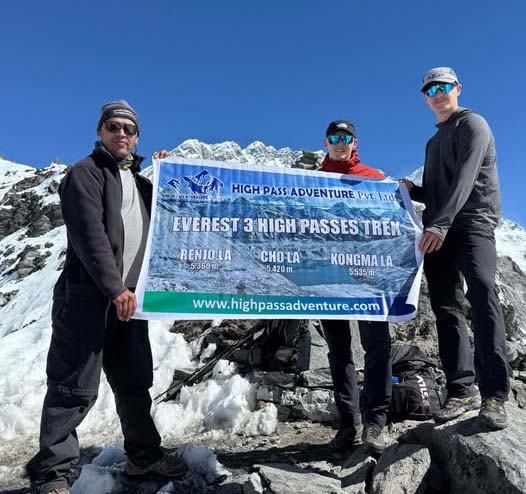
The trek crosses three high passes: Renjo La Pass (5,465 m), Cho La Pass (5,425 m), and Kongma La Pass (5,535 m). This route provides the ultimate high-pass trekking experience in the Everest region, giving a deeper understanding of the harsh terrain, cold climate, and high-altitude challenges compared to the regular Everest Base Camp Trek.
This high-level trek requires good health, physical fitness, and strong determination, as trekkers will walk long days (8–9 hours) over challenging ascents and descents while crossing these high passes.
The trek is made unforgettable with stops at the most famous destinations in the Everest Region, including Everest Base Camp, Kalapathar, Gokyo Lake, Tengboche Monastery, and Namche Bazaar. For adventure trekkers seeking a high-pass trekking experience combined with Everest Base Camp in a single itinerary, this is the ideal journey.
Additionally, the trail passes through remote Sherpa villages, from Lukla to Chukung via Namche, Tengboche, Dingboche, and Thame, crossing the three high passes and visiting Everest Base Camp and Gokyo Lakes.
Along the trek, you will be welcomed by four “above-eight-thousand” peaks: Mount Everest (8,848 m), Mount Lhotse (8,516 m), Mount Makalu (8,463 m), and Mount Cho Oyu (8,201 m), along with many peaks below 8,000 m. This trek is a perfect combination of adventure, Sherpa cultural experiences, visits to historic monasteries, breathtaking Himalayan scenery, and encounters with wildlife such as Himalayan tahr, deer, and birds along the route.
Choosing whether to trek the Everest Three High Passes route clockwise or anticlockwise depends on the trekking agency and guide. Based on our experience, our itinerary follows the anticlockwise route, which is also the most commonly chosen option by trekkers.
The anticlockwise route is ideal for gradual acclimatization and offers a more social trekking experience. With extra acclimatization days in Namche Bazaar and Dingboche, trekkers cross the first high pass, Kongma La (5,535 m), in a safer and more comfortable way. After this, the trail continues with smoother elevation gains toward Everest Base Camp and Kalapathar, followed by easier crossings of Cho La Pass and Renjo La Pass via Dzongla and the Gokyo Valley.
In the anticlockwise direction, the passes are crossed in the following order: Kongma La (5,535 m), Cho La (5,420 m), and Renjo La (5,360 m), allowing a steady and well-managed altitude progression. Additionally, according to Buddhist tradition, trekking in an anticlockwise direction is believed to bring good fortune.
We remain fully flexible and are happy to follow your preferred itinerary, whether clockwise or anticlockwise. Both route options are available, and our experienced guides can easily accommodate your choice. While the anticlockwise route can be busier up to Dingboche due to trekkers heading toward Everest Base Camp, both directions offer breathtaking scenery and an unforgettable Himalayan adventure.
Day 1: Arrival in Kathmandu and transfer to a hotel.
Day 2: Trek Preparation day in Kathmandu (1350 m) overnight at Kathmandu hotel
Day 3: Fly from Kathmandu or Ramechap to Lukla (2850m) and trek to Phakding (2610m) Duration: 4-5 hours.
Day 4: Trek from Phakding to Namche Bazaar (3,440m) Duration: 6-7 hours.
Day 5: Rest day at Namche Bazaar for acclimatization.
Day 6: Trek from Namche (3440m) to Tengboche (3,867m) Duration: 5-6 hours.
Day 7: Trek from Tengboche to Dingboche (4,260m) Duration: 6-7 hours.
Day 8: Rest day at Dingboche for acclimatization.
Day 9: Trek from Dingboche to Chukhung (4,750m) Duration: 2-3 hours.
Day 10: Trek from Chukhung to Kongoma-la 5,535m and to Lobuche (4,928m) Duration 7-9 hours.
Day 11: Trek from Lobuche to Gorak Shep (5170m) & Everest Base Camp (5364m) & return to Gorakshep Duration: 6-7 hours.
Day 12: Trek from Gorakshep to Kala Patthar (5550m) & then to Dzongla (4830m) Duration 6-7 hours.
Day 13: Trek from Dzongla to Cho-la pass (5367m) & down to Thangnak (4750m) Duration: 7-9 hours.
Day 14: Trek from Thangnak to Gokyo (4,750m) Duration: 3-4 hours.
Day 15: Trek from Gokyo to Renjo-La Pass (5360m) & descend to Marlung or Thame (4210m/3880m) Duration 7-9 hours.
Day 16: Trek from Thame /Marlung to Monjo (2860m) via Namche Bazaar (3,440m) Duration: 5-6 hours.
Day 17: Trek from Monjo to Lukla (2,860m) Duration: 6-7 hours.
Day 18: Fly back to Kathmandu or Ramechhap and transfer to respective hotels
Day 19: International departure
The cost of the Everest Three High Passes Trek (anticlockwise route) is USD 1,650 per person, based on a minimum group size of two participants. This price is calculated according to our standard 19-day itinerary, covering your arrival and departure in Kathmandu.
The cost includes all transportation, accommodation, meals during the trek, a professional guide, porter services, and all required permits. Full details can be found in the Cost Includes and Cost Excludes sections. Our pricing is transparent, reasonable, and designed to offer excellent value with high-quality service for all trekkers joining us on this adventure.
The total cost may vary depending on factors such as the trekking itinerary, level of service selected, trekking season, agency choice, group size, and overall trek duration. Additional considerations include your preferred comfort level, whether you hire a guide and/or porter, and the mode of transportation.
Please note that the price does not include emergency evacuation, travel insurance, personal trekking equipment, beverages, or luxury accommodation upgrades. However, we guarantee competitive pricing with no hidden costs, ensuring a smooth, stress-free planning experience and outstanding service throughout the Everest Three High Passes Trek.
Booking the Everest Three High Passes Trek with High Pass Adventure ensures a well-organized, safe, and truly memorable trekking experience in the Everest region. There are many reasons why trekkers choose us for this challenging adventure:
Experienced Guides and Porters: High Pass Adventure provides highly experienced, government-licensed guides who are deeply familiar with the Everest region and the Three High Passes route. Our guides ensure your safety while sharing valuable insights into local culture, lifestyle, and the Himalayan environment. We also provide strong and experienced porters, which is essential for this long, high-altitude, and physically demanding trek, allowing you to walk comfortably and enjoy the journey.
Customized and Flexible Itineraries: We tailor our itineraries to match each trekker’s fitness level, preferences, and timeframe. Every client is unique, and we understand that personal needs vary. Our flexibility allows us to adjust plans in case of weather changes or unforeseen conditions, making your trek smooth and stress-free.
Quality Services at a Fair Price: High Pass Adventure offers affordable pricing without compromising on quality. Our services include comfortable accommodations, nutritious meals, reliable transportation, and professional staff—so you can fully focus on enjoying the trek rather than worrying about logistics.
Safety as Our Top Priority: Your safety is our highest priority. Our guides are trained in first aid and high-altitude rescue procedures, and we provide all necessary safety equipment. We continuously monitor your health and acclimatization throughout the trek because client safety is the foundation of High Pass Adventure.
Transparent Pricing & Hassle-Free Booking: Our pricing is clear and transparent, with no hidden costs. All inclusions are clearly outlined in the cost-included section, so you know exactly what you are paying for. We pay our guides and porters above the government-fixed wages, ensuring a motivated and professional team. Our booking process is simple, secure, and hassle-free, making your trip planning smooth from start to finish.
Positive Reviews and Strong Reputation: We are proud of our excellent reviews and strong reputation built through years of delivering memorable trekking experiences. Positive feedback from our clients reflects our commitment to quality service and reliability in the trekking community.
99% Trip Success Rate: Since 2017, we have successfully guided hundreds of trekkers from around the world on the Everest Three High Passes Trek, achieving an impressive 99% success rate.
This success is thanks to our experienced guides and dedicated porters who carefully monitor everythings, serve freshly cooked meals, and arrange the best available accommodations. With their deep regional knowledge and high-altitude expertise, you can trek with confidence—knowing you are in safe and capable hands every step of the way.
The Everest Three High Passes Trek involves crossing three major high-altitude passes: Kongma La Pass, Cho La Pass, and Renjo La Pass. This is one of the most challenging and rewarding treks in Nepal’s Everest region, best suited for experienced trekkers. The trek is famous for its dramatic scenery, remote and rugged terrain, and breathtaking views of iconic peaks such as Mount Everest, Lhotse, Nuptse, Makalu, and many others.
Kongma La Pass (5,535 m): Kongma La Pass is the first pass crossed on the anticlockwise route of the Everest Three High Passes Trek. Located between Everest Base Camp and the Chhukung Valley, it sits at an altitude of 5,535 meters (18,159 feet) above sea level. This pass is renowned for its stunning panoramic views of surrounding Himalayan giants, including Lhotse, Makalu, and other peaks. Crossing Kongma La is both physically demanding and highly rewarding, making it a true highlight of the trek.
Cho La Pass (5,420 m): Cho La Pass is the second high pass of the trek, situated between the Gokyo Valley and the Everest Base Camp Valley at an altitude of 5,420 meters (17,782 feet). Known for its challenging terrain and icy sections, Cho La offers incredible views of Everest, Lhotse, Ama Dablam, and surrounding peaks. This dramatic crossing adds excitement and adventure to the Everest Three High Passes Trek.
Renjo La Pass (5,360 m): Renjo La Pass is the third and final pass of the anticlockwise route, located between the Thame Valley and Gokyo Valley at an altitude of 5,360 meters (17,585 feet). Renjo La is often considered the best viewpoint of the trek, offering breathtaking panoramic views of Everest, Lhotse, Makalu, and the stunning Gokyo Lakes below. Its scenic beauty makes it one of the most memorable highlights of the entire journey.
Safety is extremely important when trekking in the Himalayan region, and this is especially true for the Everest Three High Passes Trek. Trekkers should always walk cautiously and carefully along the trail, as the paths can be rocky, steep, and slippery—particularly during rain or snowfall. These conditions are common in late May, early September, and throughout the winter months of December, January, and February.
At higher elevations, especially while crossing the passes, snow and ice can make the trails more challenging. Melting snow may also cause muddy and slippery sections, so extra care is required when walking near cliffs and High Mountain passes.
The Everest Three High Passes Trek is a demanding adventure that requires an experienced guide and a strong focus on safety. Choosing a reputable trekking agency with knowledgeable and professional guides is essential to ensure a safe, enjoyable, and well-managed journey through the breathtaking Everest region. Weather conditions at high altitude can change rapidly, making proper planning and quick decision-making crucial.
At High Pass Adventure, client safety is our top priority. Our trekking program includes proper acclimatization days to help prevent altitude sickness. This itinerary has been carefully designed by experienced guides who have successfully completed the route many times.
Our guides are government-licensed, trained in first aid and high-altitude safety, and are always equipped with essential medical supplies, including a first-aid kit and a pulse oximeter. Before the trek begins, they provide a comprehensive safety briefing covering altitude sickness, emergency procedures, and trekking best practices. Throughout the trek, guides closely monitor your health and well-being.
The trek also involves flights to and from Lukla, which has a short and challenging airstrip. Due to unpredictable weather conditions in the Himalayan and hilly regions, flight delays or cancellations between Kathmandu and Lukla can occasionally occur. While we always aim to create the best possible itinerary, we strongly recommend allowing extra buffer days before and after the trek to handle any unforeseen delays.
Our trekking staffs are highly experienced, professional, and skilled in problem-solving, ensuring smooth handling of unexpected situations. With our expert team and strong safety measures, you can focus on enjoying the adventure and the incredible Himalayan scenery with confidence and peace of mind.
The 19-day Everest Three High Passes Trek, from your arrival in Kathmandu to your return home, is a challenging yet highly rewarding adventure due to its long duration and demanding high-altitude terrain. This journey takes you from approximately 2,800 meters to 5,545 meters, passing through farmland, terraced fields, diverse landscapes, narrow trails, forests, moraines, glaciers, and rocky paths.
The trek includes crossing three major high passes: Kongma La Pass (5,535 m), Cho La Pass (5,420 m), and Renjo La Pass (5,360 m). It involves frequent ascents and descents, with daily walking times of 5 to 8 hours. Therefore, proper preparation is essential to ensure a safe, successful, memorable, and enjoyable trekking experience.
Good physical fitness, hiking training, mental resilience, and strong determination are key requirements for this trek. You should build endurance and strength through regular activities such as walking, day hiking, running, biking, jogging, stretching, and swimming. Booking your trip with an experienced and reputable trekking agency and hiring a professional guide is also an important part of your preparation.
Packing the right trekking gear suitable for all seasons—while keeping it light and essential—is crucial before joining the Everest Three High Passes Trek.
Another important aspect of preparation is seeking medical advice before travel, especially if you have respiratory issues or other health concerns, including food or drink allergies. Travel insurance is mandatory and we strongly recommend coverage that includes emergency helicopter evacuation, as the trek takes place in a remote high-altitude region where medical facilities are limited.
With proper planning, training, and preparation, you can confidently complete the Everest Three High Passes Trek and enjoy one of the most iconic and adventurous trekking experiences in the Himalayas.
The itinerary provided below is a general guideline for the Everest Three High Passes Trek. If you already have your own itinerary, we are happy to follow it. If not, we can create a customized itinerary based on your preferences, available vacation time, budget, and schedule.
Please be aware that flights to and from Lukla are highly weather-dependent, and delays or cancellations are common. In such cases, you may need to add a few extra days to your itinerary, as weather conditions in the mountains can change quickly. We will do our best to adjust the schedule accordingly and rebook you on the next available flight.
If you have limited time before or after the trek, you may consider taking a helicopter flight to or from Lukla, or alternatively choosing a trekking route in a different region. To avoid the risk of missing your international departure, we strongly recommend adding at least one or two extra buffer days to your travel plan to accommodate
High Pass Adventure warmly welcomes you to Nepal at Tribhuvan International Airport (TIA). A member of our team will be waiting for you outside the baggage hall, holding an A4-sized paper with your name and our company name.
This representative will escort you from the airport to your hotel in Kathmandu via a private vehicle. Upon arrival at the hotel, you can check in, rest, and freshen up before attending a meeting at our trekking office to discuss the details of your Everest Three High Passes Trek program.
This day is scheduled as an extra day in Kathmandu for trekking preparation and rest after your long international flight to Nepal. You can relax in the morning, and in the afternoon our guide will review and check your trekking and climbing equipment to finalize your clothing and gear. The guide will also help you decide what to take on the trek and what to leave at the hotel, as well as identify any missing items that may need to be purchased. This day will be flexible and dedicated to trek preparation, and the journey will begin the following day.
Our trekking guide will arrive at your hotel on time to transfer you to the domestic terminal of Tribhuvan International Airport by private vehicle for your flight to Lukla. You will board a scenic 35-minute flight to Lukla (Tenzing-Hillary Airport) with your trekking guide.
During the peak trekking season, Lukla flights operate from Ramechhap instead of Kathmandu. If this is the case, you will need to leave early in the morning, around 2:00 AM, as it takes approximately 4 hours to reach Ramechhap by road.
Upon arrival at Lukla, you will meet your trekking porter, who will be introduced to you at the Lukla airport. They will already be waiting for you.
The trek begins from Lukla after passing through the Pasang Lhamu Memorial Gate and walking through the bustling Lukla town. The trail descends to Phakding Village, passing through Chheplung, Thado Koshi, Ghat, and sections of forest. Along the way, you will be treated to stunning views of Kusum Kangru and Kongde Peak.
From Phakding, the trekking trail continues north toward the Khumbu Valley. The route involves a mix of uphill and downhill sections, passing through forests of pine and rhododendron, crossing suspension bridges, and walking through local Sherpa villages before reaching Monjo. Monjo serves as the gateway to the Sagarmatha National Park and Everest Region Trekking including Everest Three high Passes Trek.
Our trekking guide will arrange the Sagarmatha National Park entry permit. From the Monjo Gate, the trail descends to a bridge over the Dudh Koshi River, leading to Jorsalle village. From Jorsalle, the trail continues north, crossing another bridge over the same river. Following the riverbank, you will arrive at a large confluence known as Dovan. Here, you will cross a high suspension bridge over the Dudh Koshi River.
After crossing the bridge, the trail ascends through a pine forest with a series of zigzag paths leading to Namche Bazaar. Before reaching Namche Bazaar, you will be rewarded with your first views of Mt. Everest and other stunning peaks, making the climb truly unforgettable
After reaching an altitude above 3,000 meters, it is essential to stay an extra night for acclimatization. Namche Bazaar, situated at an elevation of 3,440 meters, is a beautiful town and the ideal place to spend an additional night. Staying two nights in Namche helps you adjust to the higher altitude for the trek and climb ahead.
During the acclimatization day, a hike to higher altitudes is recommended. There are several excellent options for day hikes, such as Thame Village, Khunde, Everest View Hotel, or Khumjung Village. Your trekking guide will plan the hike based on your preferences and condition.
After breakfast, you can visit any of these destinations. All hiking routes offer stunning panoramic views of the mountains, pine forests, Mani walls, Buddhist monasteries (Gompas), and traditional Sherpa villages
You can also spend your remaining time visiting the National Park Headquarters and Museum to learn about the region's flora, fauna, and culture, or simply relax at your hotel and enjoy the views.
After having breakfast in Namche, the trekking trail follows the path through Chorkyang. From Chorkyang, you will head north, passing a memorial chorten dedicated to Tenzing Norgay. Along the way, you can enjoy breathtaking panoramic views of peaks such as Kusum Kanguru, Thamserku, Khangtega, Ama Dablam, Lhotse, Everest, Nuptse, and Taboche before reaching Kyanjuma.
From Kyanjuma, the trail descends to the Dudh Koshi River, where you will cross a bridge at Phunki Thanga. After crossing the bridge, the trail ascends steadily through a lush forest of pine and rhododendron trees, leading to Tengboche. If you are lucky, you may spot wildlife like deer and pheasants along the way.
At Tengboche, there is a famous Buddhist monastery called Tengboche Monastery. After breakfast in Tengboche, you will visit this renowned monastery to explore its serene environment and spiritual significance.
After the monastery visit, you will continue trekking toward Dingboche. The trail initially descends for about 30 minutes through a lush green forest to reach Debuche. From Debuche, the trail leads to the Imja River, where you will cross a suspension bridge. After crossing the river, the trail ascends gradually through Pangboche, Somare, and Orso before reaching Dingboche.
This day's trek can be a bit challenging due to the increasing elevation, but you will be rewarded with breathtaking mountain views along the trail.
Dingboche, situated at an altitude of 4,400 meters, is a crucial stop for acclimatization before ascending further toward destinations like Everest Three High Passess, Everest Base Camp and Kalapathar. Spending an extra night here is essential to adapt to the high altitude and prepare for the upcoming challenges.
For acclimatization, there are two popular hiking options: Nagarkhang Hill and Chhukung Village. After breakfast at your hotel in Dingboche, your trekking guide will plan the day's hike. A full-day hike to Nangkar Tsang Hill is a common choice.
Both locations offer stunning panoramic views of Mount Makalu (8,516 m), Lhotse (8,516 m), Baruntse (7,129 m), and other prominent peaks in the region. These hikes not only provide breathtaking scenery but also help your body adjust to the altitude, ensuring a safer and more enjoyable journey ahead.
After breakfast in Dingboche, the trek begins at a relaxed pace with a 3–4 hour walk to Chhukung. The trail gently ascends through the Imja Khola Valley, passing alpine and barren landscapes, along with stone-walled fields.
Along the way, you’ll enjoy spectacular mountain views of Mt. Lhotse, Mt. Ama Dablam, and Island Peak. Imja Tse (Island Peak) stands out with its striking pyramid shape, stepped rock formations, and icy south face.
Chhukung is a fantastic place to explore nearby glaciers and take in the dramatic surroundings of massive, snow-covered Himalayan peaks.
Today is a long and challenging day as we cross the first high pass, Kongma La (5,535 m). We start early after breakfast to make the most of stable morning weather. Be sure to carry plenty of water, snacks, and a packed lunch, as there are no teahouses or shops along the route until Lobuche.
The trail heads northwest from Chhukung, crossing the moraine of the Nuptse Glacier, or alternatively descends briefly to Bibire before following a high trail above the Niyang Khola. Shortly after starting, you’ll enjoy stunning views of Island Peak Valley and the dramatic ridge of Amphu Lapcha.
Ascending along the east side of the Niyang Khola Valley, the trail turns west and continues over slippery, rocky terrain. We then enter a wide basin scattered with small frozen lakes, before climbing steeply over loose scree to reach Kongma La Pass, approximately five hours after leaving Chhukung.
At the top of the pass, marked by cairns wrapped in prayer flags, breathtaking views unfold. Behind us lay the icy lakes, while ahead stretches the vast Khumbu Glacier. The descent from the pass is the most demanding section of the day, requiring careful footing over steep moraines.
After descending, the trail turns north across the Khumbu Glacier, eventually leading us to Lobuche, where we settle in for a well-earned rest at a teahouse.
This day is particularly exciting as you’ll be reaching Everest Base Camp (base of the tallest mountain of the world)! After breakfast in Lobuche, you’ll set out promptly, eager to start the day. The trekking trail ascends gradually, taking you toward Gorakshep. The route passes near the Italian Pyramid, alongside the Khumbu Glacier, and across terminal moraines.
Upon arriving at Gorakshep, you’ll have lunch and check into your room. Afterward, you’ll continue the hike to Everest Base Camp. Along the trail, you’ll be rewarded with stunning views of Nuptse, Khumbutse, Changtse, Pumori, and Lingtren.
At Everest Base Camp, you’ll spend a few memorable moments taking in the achievement of your journey and capturing photographs. After soaking in the incredible atmosphere, you’ll return to Gorakshep along the same trail for an overnight stay.
Mount Everest is not clearly visible from Gorakshep or Everest Base Camp, so an early hike to Kalapatthar is essential for the best and closest views of Mt. Everest and surrounding peaks. The hike to the summit takes approximately 1.5 hours. Your trekking guide will plan the hike and provide a detailed briefing beforehand.
From the top of Kalapatthar, you’ll enjoy spectacular 360-degree panoramic views, often bathed in golden morning light, featuring Everest, Nuptse, Pumori, and other Himalayan giants.
After soaking in the views, descend back to Gorakshep for breakfast. Once packed, continue trekking toward Zongla for the night. The trail retraces the route back to Lobuche, then descends for about 30 minutes to a glacial stream, which you will cross before heading northwest across barren alpine terrain.
Along the way, enjoy stunning mountain vistas and dramatic landscapes that may have been overlooked during the ascent, before arriving in Zongla for an overnight stay at a teahouse.
Today is another challenging and rewarding day as we cross Cho La Pass, the second of the three high passes, while trekking from Dzongla to Dragnag. Due to the long walking hours at high altitude, an early breakfast and early start are essential.
The trail begins with a gentle ascent for about one hour, followed by a steeper climb for approximately two hours. After this, the route continues across snow and glacier terrain for another hour to reach the top of Cho La Pass (5,420 m). This section can be demanding, as the trail is often rocky, icy, and snow-covered.
Upon reaching the summit, take time to rest and enjoy the magnificent panoramic mountain views. The descent from Cho La is steep and technical, requiring careful navigation across icy and rocky terrain for about two hours. This is followed by another two hours of walking on barren, rocky trails before reaching Dragnag, where you will spend the night at a tea house.
Our well-experienced and genuinely knowledgeable trekking guides and the best porters at High Pass Adventure have been working together to provide excellent service, ensuring a quality tour that creates a lifetime of memorable experiences. We pay our trekking and tour guides and porters salaries that are higher than the government-fixed amounts. All our costs are transparent; clearly detailing what is included and excluded. You can follow the listing below for more details about the costs:
Note: Occasionally, flights to or from Lukla may be delayed or canceled due to bad weather, which could affect the completion of your trek on time. In such cases, a helicopter flight can be arranged as an alternative. The cost for a shared helicopter flight is $500 per person one way (either Kathmandu to Lukla or Lukla to Kathmandu) but requires a minimum of 5 passengers.
Get Free Quotes , Tailor Your Trip
© 2011 - 2026 All rights reserved. High Pass Adventure Pvt. Ltd. Developed By : Xenatech Nepal